What is it about?
This is not a biography. It is a visual ode to the life of Sayat-Nova, an Armenian poet, weaving a mesmerizing tapestry of his journey through symbolic imagery and poetic storytelling. Each frame is a vibrant canvas, painting a portrait of his life, from childhood innocence to artistic brilliance, in a lyrical and spiritual exploration of identity and culture. This film intricately melds art, history, and the essence of human existence into a breathtaking cinematic experience.
What is it really about?
Sayat Nova: The king of song. A poet with incomparably acrobatic word stitches of the Armenian language, Georgian, Azerbaijani, Persian and Arabic, crocheted in the finest, most delicate harmonies of the musical carpets in which he wraps himself and protects his listeners from the dirty desert sand.
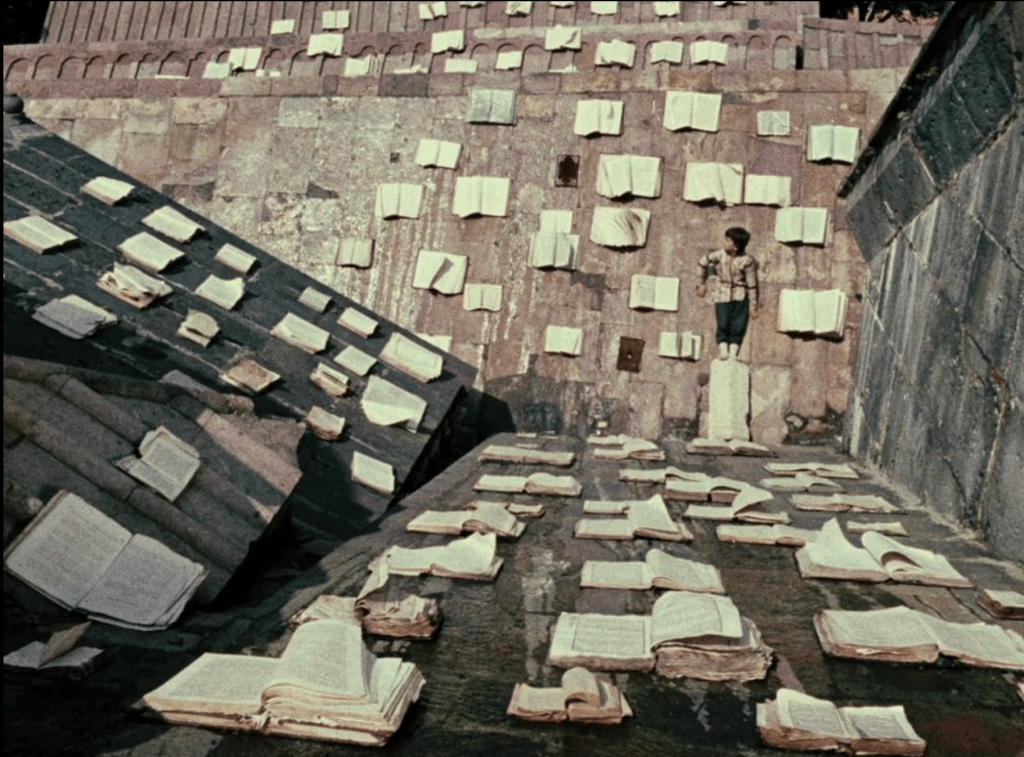
His child: a blossoming in the rain-soaked monastery libraries, the sacredly scooped walls, when after a torrential downpour the devastating amniotic fluid has to be squeezed out of the drunken writings so that every word and every sentence of these writings are protected and do not blur obscurely forever. These writings, squeezed like oranges, a boy guards and gives them to the sun god to read as they spread their leaves like angel wings and beat with the wind, drumming out a sound from the liturgies and allegories the boy hears them sing together. In the silent moments that follow, slumbering in the daily chores and ablutions, promising whispers shimmer forth; the rustle of shells on milky, faded breasts.
His youth: a bulbous lute whose plucked strings set the world and her ears vibrating, the instrument of elegiac compatibility, gently carried by a boy who translates his inner world musically and poetically into lute playing, eagerly reproducing the former angelic sounds of writings flapping in the wind. Having grown up in a hormonal frenzy, the boy gives his mood to a young man and shortly afterwards merges with the young man himself. Behind a white veil of innocence, a young woman masks her flirtation. With elegantly waving fingers, she crochets the tip of her veil into an impenetrable fabric to keep her innocence eternal, but she separates all the threads of her veil when the young man sends her his ear-pleasing lute playing and his eloquent poetry. The veil of innocence is lifted, the mask disappears and her face floods the room with her heart. As a breeze blows through the agitated room at dusk, not only has the woman slipped away from the veil, but also the young man from his lute and his poems.
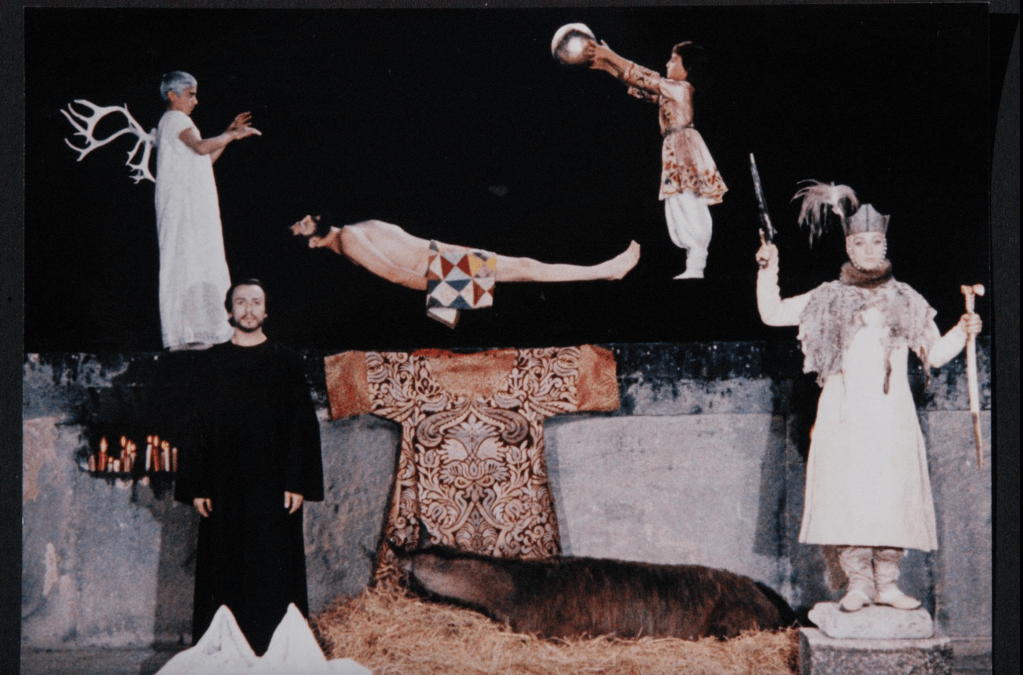
His life in the princely court: a courtly spectacle among princes and dukes, swaying in a tumbling dance, dully rattling their sabres, circling around the root-like antlers of killed sacred stags, obeying the sound of their prince’s pistol at every turn and becoming amusing caricatures of themselves. Soundlessly, the lamentation of poetry degenerates into a diaphragm-slicing theater. But the fire in the longing-suffering young man blazes with every further pulsation in his veins, leaving behind heartbeat after heartbeat a burnt, ashen exterior, a dark robe in which he eviscerates his unrequited love, constantly and secretly wearing his affection like an amulet that burns deeper and deeper into his chest in the blazing fire. And when the object of his desire, the young woman, casts secret glances at him from behind her blood-guilty red veil, what must not be and what is forbidden happens, forcing the guilty man with the burnt heart in his chest to hide his face behind a black veil and bury their shared love forever.
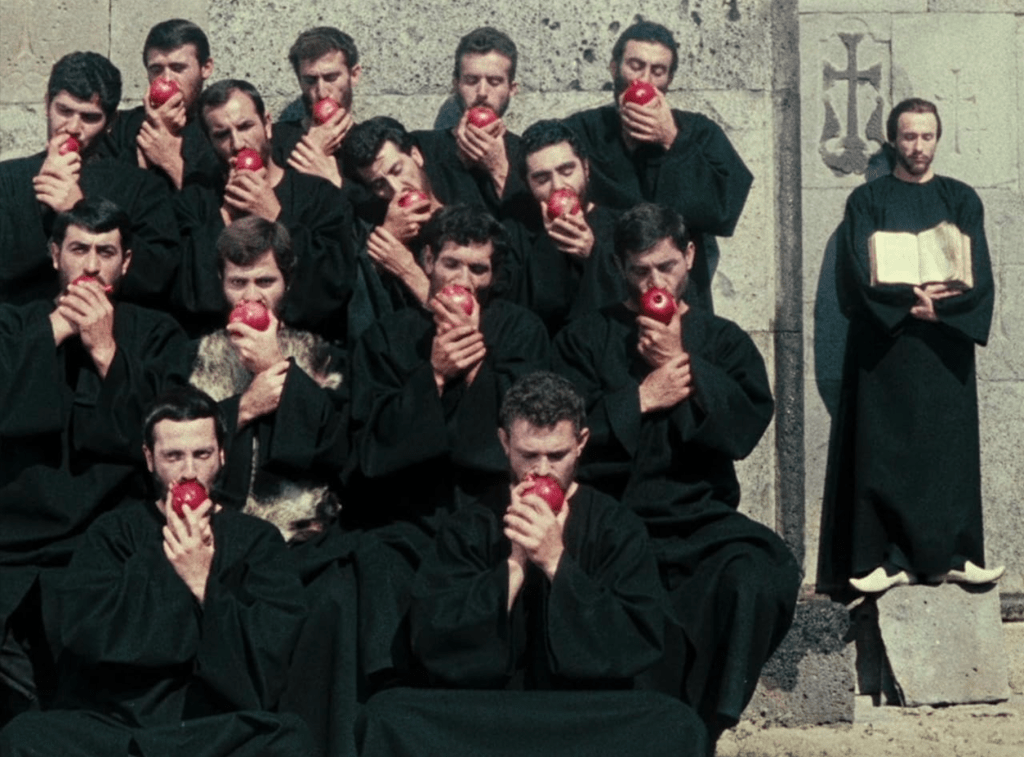
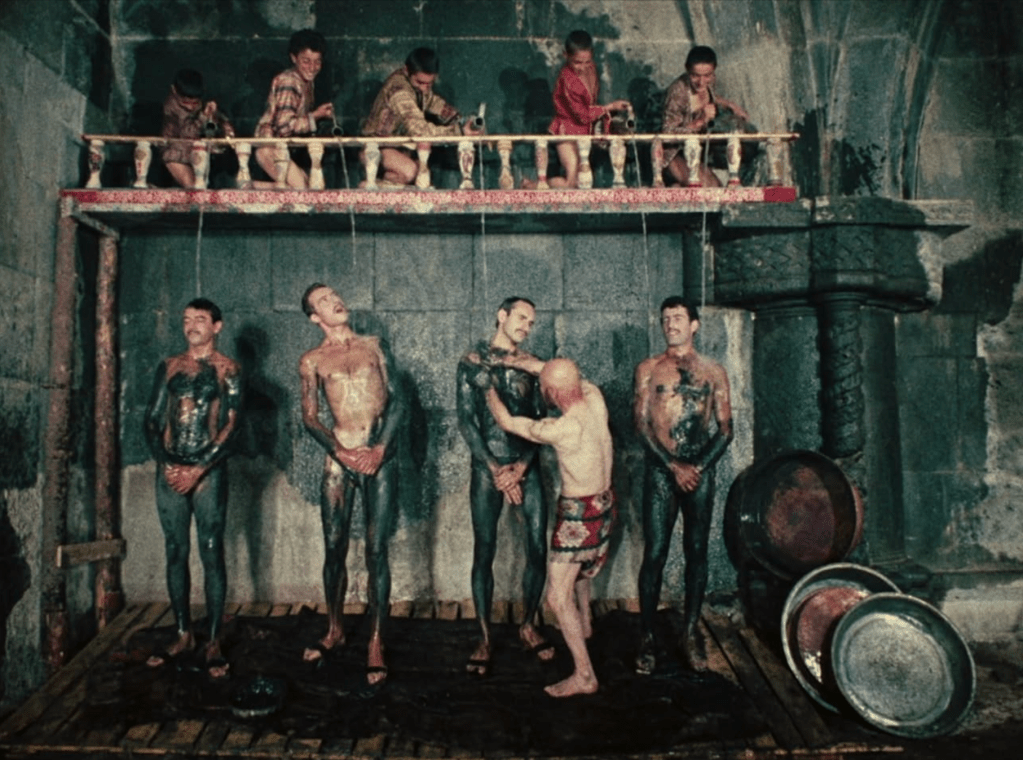
His life in the monastery: in the impenetrable, black thicket, a single monument shines out, a monastery to which the young man sacrificially devotes himself, shedding his robes, his longings and desires, chagrined never to be more than a mute and celibate clergyman among mute and celibate clergymen, he, a priest and the other monks, whose desires culminate in the passionate, lustful consumption of pomegranates, feasting on them and indulging themselves. A monastery supported by pillars of ceremonial. Devils are banished from the pores of the skin in ablutions. Intoxicating juices are fermented from the sweet grape fruits. Prayers for the dead, marriages under white veils, baptisms. A concatenation of human moments, in the sacred halls of this house of God, enclosed by holy water that flows like wrists in underground corridors, gushing from cracks in the walls and quenching the thirst of the clergy.
His dream: a mechanical, golden-steel hand that reaches into the body of thought and weaves a new one from the universe of feelings and memories, turning the gaze to childhood and youth, even mirroring the paternity of his own father to his son with his own paternity, while the long-dormant mother, holding hands, gives birth to a united smile. In the unconscious imitation of the father, childhood and old age merge with the symbolically hewn stones that decorate that monastery of then and now, in the comforting trumpets of the wandering musicians, which made the children’s ears grow and in those torn and dyed sheep’s wool gave the wearers an ornamental being and nourished and warmed both young and old. It is both an arrival and a farewell.
His twilight years: exhausted by memories, the monastery lingers with dry eyes and dry watercourses, letting itself be embraced by plants like a Faustian force of nature. The wandering faces are devoted, sacrificing their blackest coats to beg for forgiveness and hope in pure white robes; they sharpen their knives on sheep and goats at the same time to soak the stone floors of the monastery with blood so that the life-giving water finds its way back into the furrowed monastery walls, torrent-like, to free the dry, thirsty throats from their stranglehold. But the stranglehold turns into severed heads, severely beaten by foreign enemies who fight battles against God and against the defenders of God, finally even tearing the face of God from the skull of the monastery, until the monastery lies in shambles, ruined and destroyed.
His encounter with the angel of death: In the remains of the monastery, the stained-glass windows with golden frames, the half-shattered foundations resting firmly in the grass-clouded ground like Stone Age gravestones, angels drift about, paying homage to the last works of art that did not fall victim to the enemy. But it is too late. A woman in white is lowered into the fertile ground. The mother? The love? Innocence?
His death: the last drop of a butchered pomegranate flows from the sullying sword. The time has come: walled in between endless crosses, the man sheds his last cloak and resignedly sacrifices himself for the encounter with the archangel, who showers him with the unctuous juice of the pomegranates, immerses his aged form in a bloody fire until his own youth hovers angelically above him and ushers in his last breath, expelling the breath of God. A painful ceremony, like the chickens that have had their heads cut off and are still writhing against death, until the candles of life are blown out by the wild fluttering. At dawn, when the smoke from the extinguished candles still rises to the sky, the farewell follows and the lute that the man, the king of song, once played so artfully, which now sticks out of the freshly closed grave, does not remain eternally with the buried, but is taken by angels who carry it into the world. While man passes away dead in infinity, his art still resounds eternally.
The Color of the Pomegranate: An artificial, strictly arranged work of art that pays homage to the poetic and compositional act of creation of the Armenian Ashyg Sayat Nova in an eye-pleasing way in over-aesthetic tableaux vivants and still lifes. It is supposed to be a biography, but any stringent narration of the biographical has to make way for momentary and rather associative life situations. So instead of retelling Sayat Nova’s life, his artistic life is brought to life with an artist’s reel of interpretation. Director Sergei Parajanov interweaves poetry and musical composition by creating a visual language that resembles an eloquent volume of poetry and using aesthetic leitmotifs and visual elements like recurring melodies, creating a film that feels extremely coherent by combining the worlds of art. A film in which we learn nothing about Sayat Nova’s life, but more about what his life felt like.
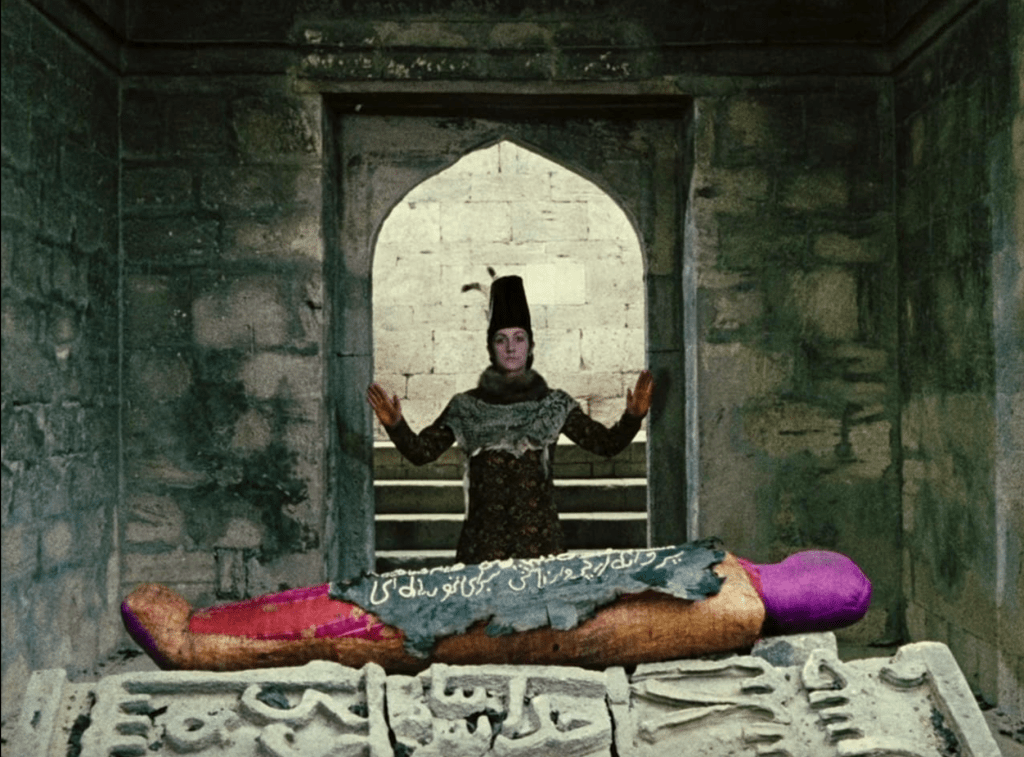
The Stranger: The Stranger rattled in amazement as the 75 minutes ticked by and now understands why The Color of Pomegranates is such a significant source of inspiration for so many artists. Through the radicalism of what is shown and the sensuality evoked in the viewer, it feels as if the rather moderately arty cardboard box between the ears is flooded with intimately hidden ideas that one wants to live out devotedly before the box bursts and everything floats away. The film is therefore an extraordinary encounter, a wild, innovative and inspiring journey into an enviably artistic world of thought full of aestheticism and sublimity.
Conclusion
It is not a movie. It is an experience.

Facts
Original Title
Length
Director
Cast
Նռան գույնը
80 Min
Sergei Parajanov
Sofiko Chiaureli as Poet as a Youth…
Melkon Alekyan as Poet as a child
Vilen Galstyan as Poet in the cloister
Gogi Gegechkori as Poet as an old man
Spartak Bagashvili as Poet’s father
Medea Japaridze as Poet’s mother
What is Stranger’s Gaze?
The Stranger’s Gaze is a literary fever dream that is sensualized through various media — primarily cinema, which I hold in high esteem. Based on the distinctions between male and female gaze, the focus is shifted through a crack in a destroyed lens, in the hope of obtaining an unaccustomed, a strange gaze.
 The Stranger's Gaze
Leave a comment