What is it about?
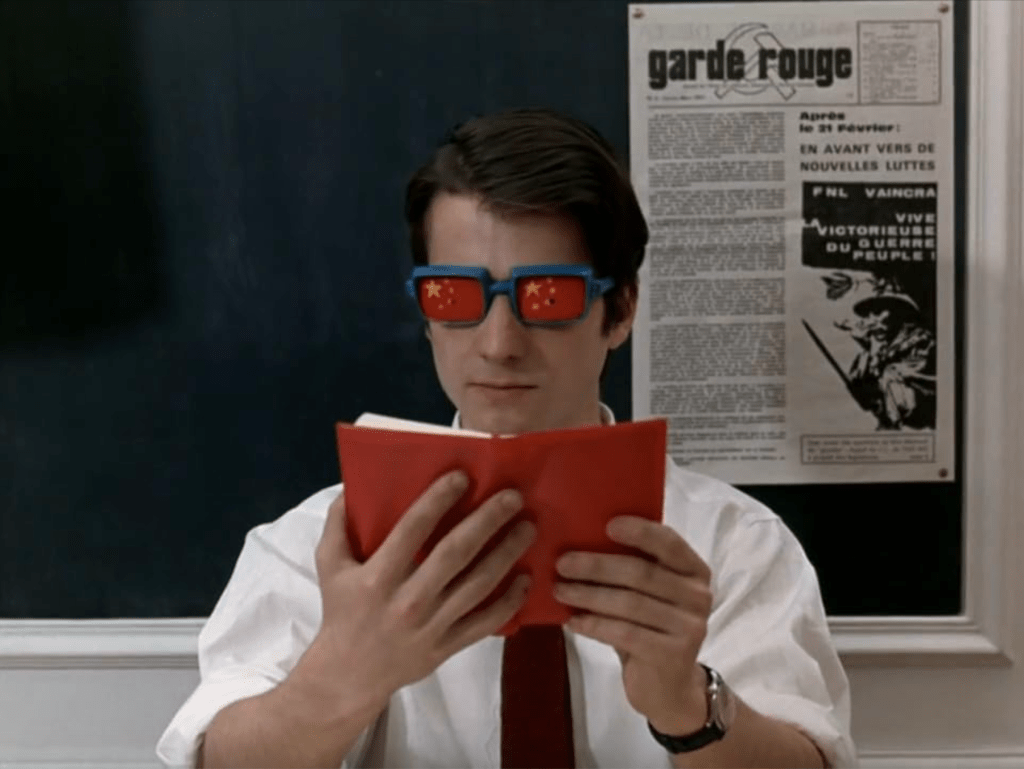
A residential community of far-left students wants to initiate communist revolution. Unfortunately, they disagree and begin to rebel against each other.
What is it really about?
Cut. A woman in a conical hat surrounded by a stack of red books; to be precise, the book “Words of Chairman Mao Tse-Tung” wrapped in red ribbon, multiple, one above the other, side by side. The book as the new masonry brick. And locked inside, a bloodied young woman wearing a traditional Vietnamese cone hat. She calls out to us. She calls out, “The Viet Cong will win.” Once. Twice. Then she is handed a rifle. A toy rifle. She unfolds it and shoots through the stack of books at the invisible enemy behind the camera. At the enemy behind the camera. She folds up the rifle. Folded up, it’s a radio. She follows the horror news announced from the radio. Cut.
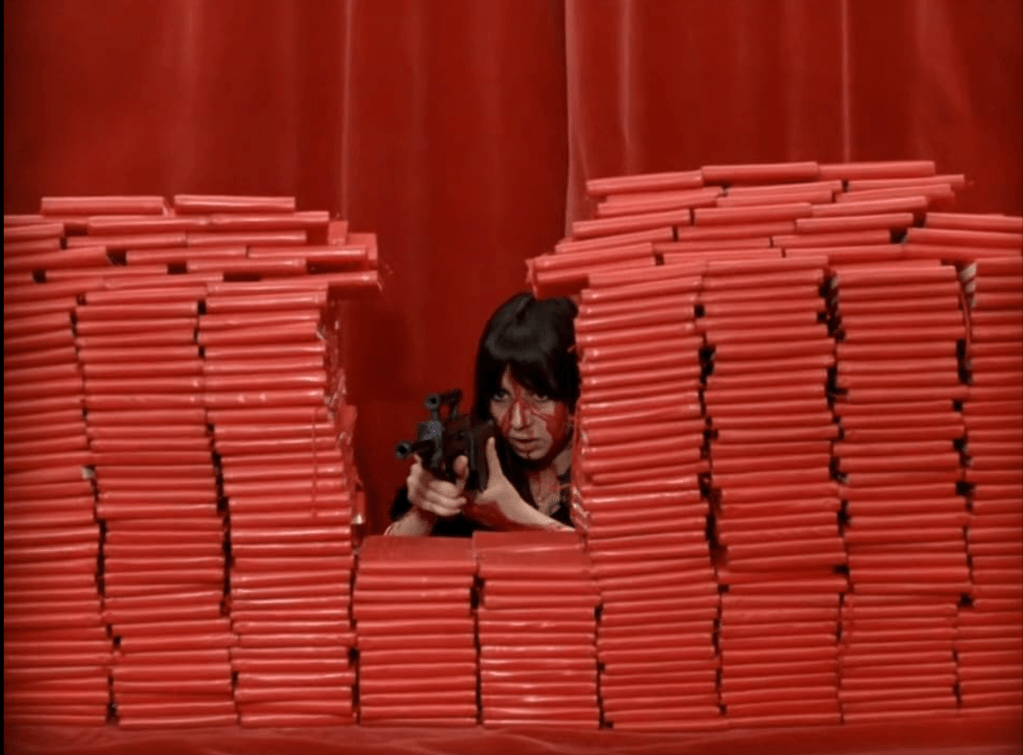
The young woman’s name is Yvonne and she lives in a shared flat with four others. The others are intellectuals from middle-class families. Yvonne is a peasant girl, a part-time prostitute and in this flat-sharing community something like a maid, who is allowed to participate in the game of the big ones only just enough to get close to victory but never to emerge as the winner.
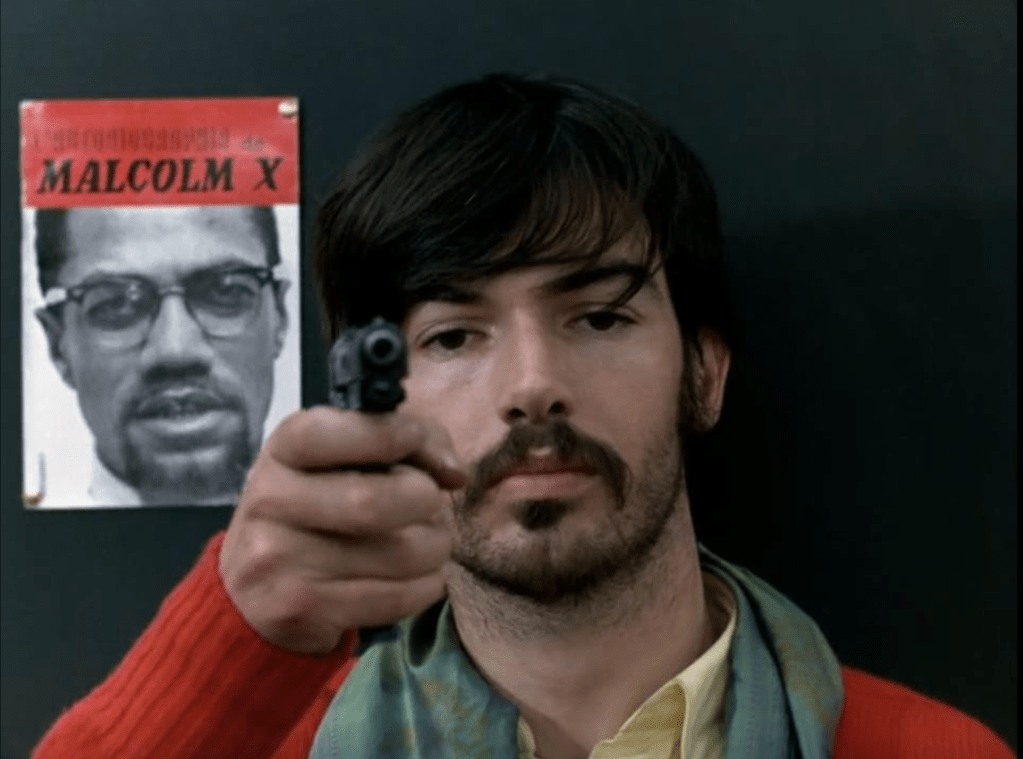
She and the four others are united by the idea of a socialist world revolution. Whereas they share the thought, it also shares their views on how the socialist revolution should take place and how the socialist society should live. The Maoists of the group want a revolution by force; the Marxist-Leninist relies on peaceful co-existence, the nihilistic anarchist keeps quiet and waits for the day when he is allowed to pull out the gun. Or not. It’s all nothing anyway. And Yvonne, the proletarian? I don’t think she understands.

In this shared flat, with the camera as a visitor, we get to know these young people. Full of ideals and ideologies. In long mutual speeches, razor-sharp word volleys are thrown around the ears. The walls are decorated with further proclamations. Poets and thinkers are erased on blackboards. Plays are performed. Literary texts are read out over bourgeois coffee and ignored by the listener. Interviews are given. Assassinations are rehearsed with bows and arrows. The socialist agenda is predominantly recited among the Residential community in front of each other. Like a lecture. Eat the spoken word to shut up. Hardly any discussion or discourse takes place among the participants. Any dissent is punished by expulsion from the group. Trench warfare under the same guise. The Popular Front of Judea versus the Judean Popular Front.
In the colorful film “La Chinoise,” Godard stages the various socialist voices through satirical, absurdist collages. Above all, however, he stages the unworldliness of the intellectuals who, in over-thinking and over-philosophizing, have inflated an ideological filter bubble consisting of a lot of hot air; who always think they are holding up the proletariat, but are as far away from the proletariat as they can get and instead integrate the only proletarian only for what she is useful for: cleaning and groping.
Thus, the film is not per se against socialist movements. Nor does it portray the characters ridiculously. It only caricatures the overambitious zealotry of some left-wing students or intellectuals, who talk a lot of smart-sounding stuff to cover up their own duplicity. Rather, it picks up on the rebellious, anti-capitalist zeitgeist of the time and exaggerates it into an ideological hall of mirrors in which the characters get lost. This is still exciting today, when the problem of filter bubbles can also be found all too often in the current world.
In any case, I laughed a lot at this film, marveled in fascination, shook my head and slapped myself on the knuckles more than once.
Conclusion
A film for all those who say “I am against it, because you are for it”.
Facts
Original Title
Length
Director
Cast
La chinoise
95 Min
Jean-Luc Godard
Anne Wiazemsky as Véronique
Jean-Pierre Léaud as Guillaume
Juliet Berto as Yvonne
Michel Semeniako as Henri
Lex De Bruijn as Kirilov
Omar Diop as Omar
Francis Jeanson as Francis
Blandine Jeanson as Blandine
What is Stranger’s Gaze?
The Stranger’s Gaze is a literary fever dream that is sensualized through various media — primarily cinema, which I hold in high esteem. Based on the distinctions between male and female gaze, the focus is shifted through a crack in a destroyed lens, in the hope of obtaining an unaccustomed, a strange gaze.
 The Stranger's Gaze
Leave a comment