What is it about?
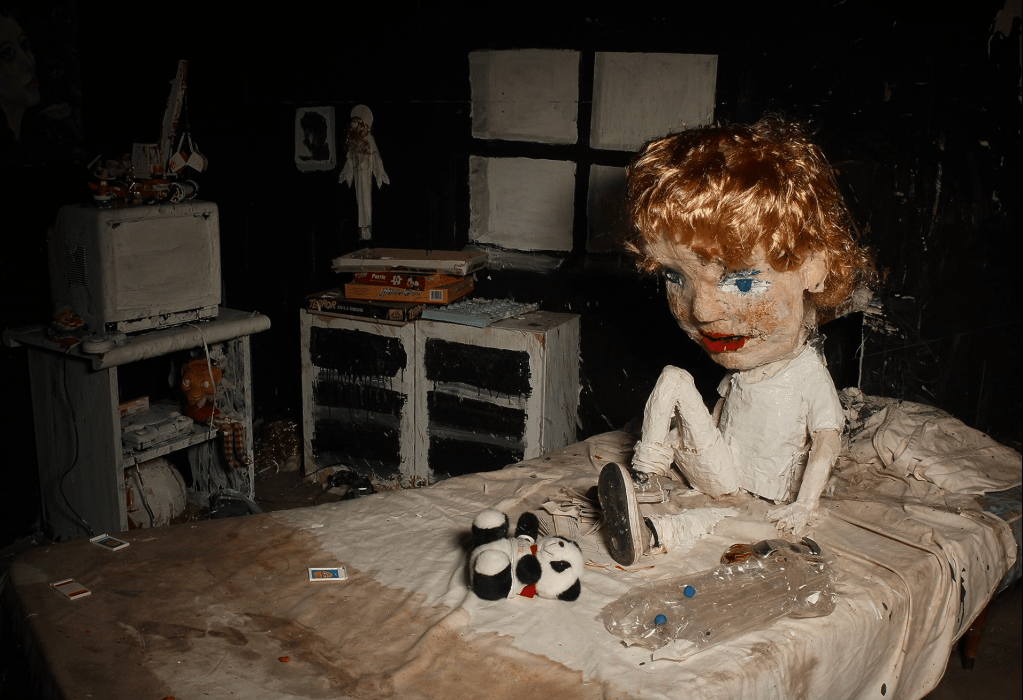
A young woman flees from a cult she grew up in and merges with the house and the two little pigs she fled with. But outside lurks a wolf that huffs und puffs und trys to blow their house down.
What is it really about?
Film. La Casa Lobo. The Wolf House. Seen again and again struck by the force. Shaken. Moved. But why?
A prologue. The beginning. From a time when the sun was still shining. An image-crunched advertising video of a Chilean colony. Apparently shot in the 70s. About a colony that promises itself to the community sacrificially and energetically. In the midst of an impressive nature that harmonizes with an impressive humanity. Flower-filled meadows. People smiling radiantly into the camera. Goats herded by a dog. Singing together as happiness in life. A world that awakens the romanticism of nature, completely secluded in the mountains of the eternally stretching Andes. Isolated from the rest of the world. Traditional, Christian, German. There they tell the fairy tale of Mary and the two pigs that became her children.
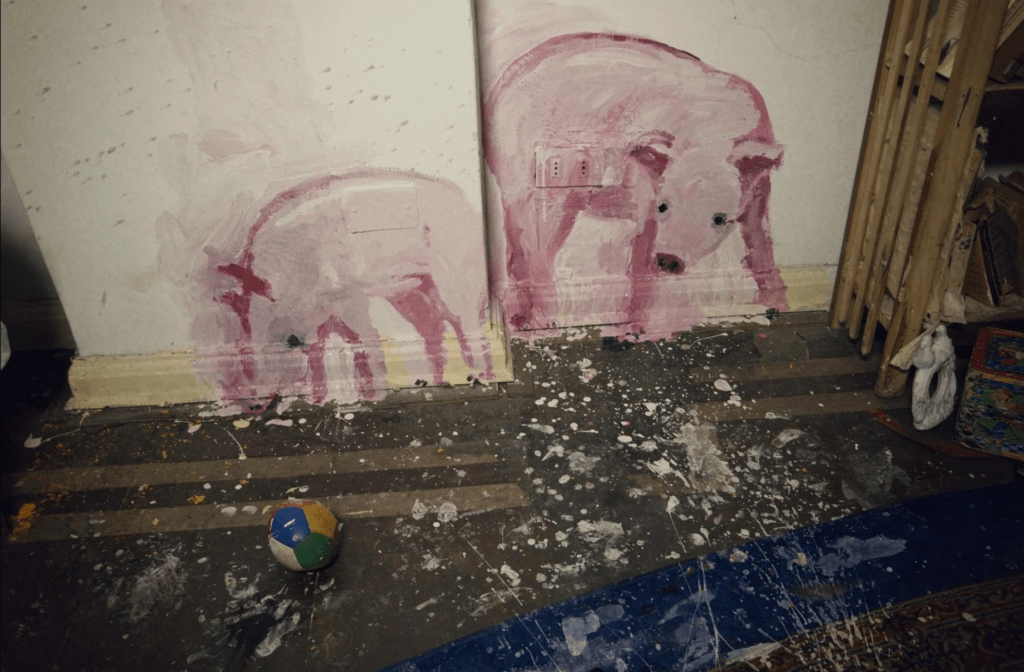
A fairy tale. A horror story. Thrown into the darkness of the night. Dark as the musty rhizomes of a withering black dahlia. Once upon a time there was a young, disobedient woman. She let three pigs escape from the barn. The punishment: for a hundred days she is forbidden to speak to others. She flees from the colony. Finds shelter in a remote, overgrown house. Surrounded by the impenetrable forest that separates cottage and colony. Soon, however, a wolf prowls around the house. He whispers and calls: Maria. His little bird. Inside the house, the young woman, Maria, finds two little pigs. A magic ball transforms the two pigs into a boy named Pedro and a girl named Ana. Maria’s children. Thus they live in the house around which Wolf circles. They live a happy life in it, where no rain falls through the roof. Finally. Finally happy. Finally a family of love, of care, of intimacy. Despite the wolf. Despite the dangers in the forest. But they do not remain happy. Nightmarishness moves in. The unforgettable ghost of the wolf inevitably makes its appearance. What is your house made of, asks the wolf. And then he blows and he blows. A fire accident, hunger, cannibalism. The decay of a family. The children who want to eat their parents. Pedro and Ana who want to eat Maria. But … the … rescue. The wolf offers Maria, his little bird, the helping claws. Thereupon Maria is silent forever. But the wolf promises, Maria is saved. Now she is happy. And if she has not died, then …
An allegory. The truth lurks under the bed. Never look down. Never. The truth is: Maria tried to escape the colony called Colonia Dignidad. A German-Chilean sect with 250 to 350 members. The promotional video in the prologue romanticizes that colony and, by extension, the humanistic whippings that the pseudo-religious cult leaders meted out over human bodies for decades – until the late 1990s. Electric shock treatments on children, corporal punishments, sexual abuses, forced labor, human abductions, executions. This is the truth. In this colony, people told the fairy tale of the disobedient Maria, who locked herself up in a house and lived there with two pigs that became human beings by magic, and were christened Pedro and Ana. A seemingly idyllic family. But due to the mother’s excessive demands, her children turn against her. Just as Mary turned against her family and turned away from them. But in this fairy tale, she was still able to save Wolf and bring him back to her family, to the colony. Now obedient. Purified and taught that disobedience and unconditional care for the children has no splendid future.
The deception. The concealment of the truth under layers of dust and oblivion. The colony did not only deceive its members. It also deceives not only with its promotional video of a peaceful commune. It also deceives with the narration of the fairy tale. Pretending as if it were Maria’s happy ending that she can go back to the colony. A happy ending that only hear from the wolf itself, not from Maria. She is silenced forever. How she will fare after her return remains veiled. A pretense that escape to other, hopeful, better lives is not worthwhile, because only the return means home. That of a colony that psychologically manipulates its youngest, forces them into dependency and castrates the possibilities for an independent life as early as possible. The fact that Maria in the fairy tale soon goes from initial happiness to ruin is partly due to her being overtaxed to develop a foothold of her own. Although she has endless love and care, she does not know how to provide for herself and her two children. She has never learned. Never been allowed to learn. Besides, the wolf lurks outside her house. The constant threat. So she can’t go berry picking in the forest without being caught by the wolf or tripping over the buried bodies in the woods. The forest as a metaphor for civilization, in which the wolf does not wander, but also swayed as a symbol he politically influential Colonia Dignidad. Maria’s end is therefore deeply dark and depressing. The story of a young woman who wants to escape from the clutches of a colony, but for whom there was no help.
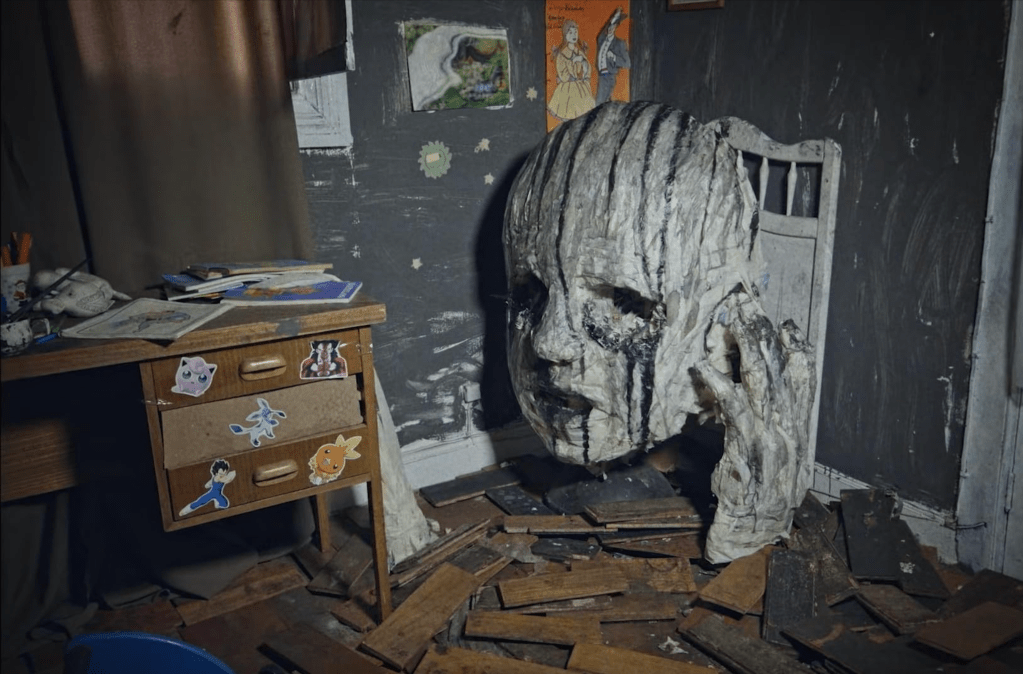
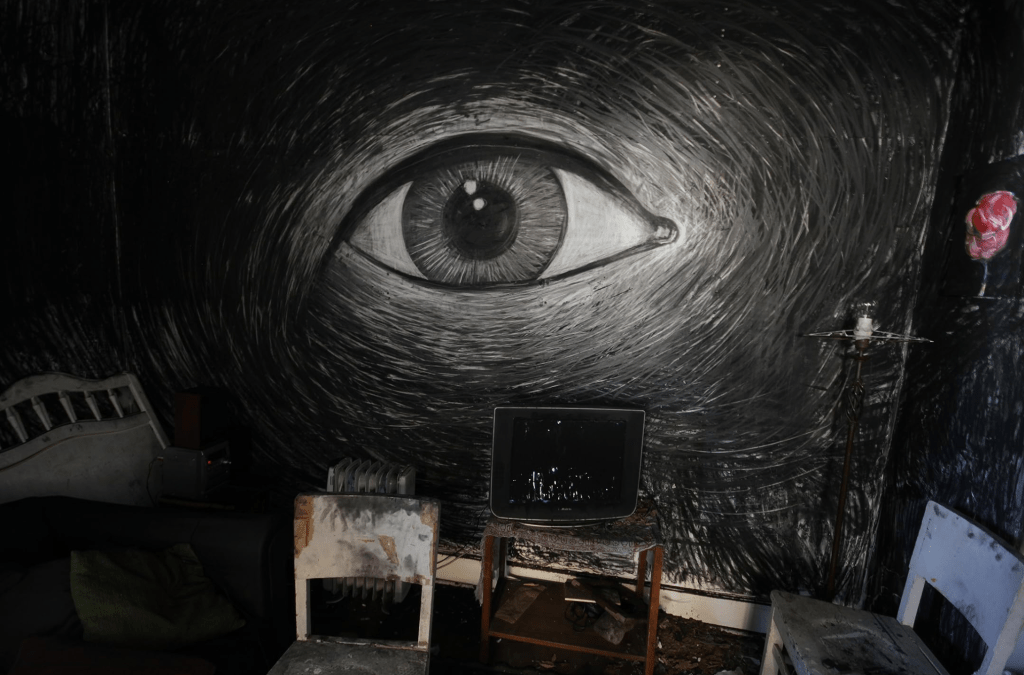
The means of expression. The remarkable thing about the film is not only the fairy tale that is told. It is the way it is told. Incomparable! The fairy tale as stop-motion animation. Frame by frame, brushstrokes on the walls of the house turn into bookshelves, pictures, magic balls. But also Maria, Pedro and Ana wander as paintings over the walls, on chairs, on beds and gradually become plastic. There are no actors. No plasticine figures. Everything is artificial and sporadically borrowed from our world. Constructed in surrealistic style maximally artful and at the same time extremely fleeting in presence. Glued together. From acrylic and papier-mâché. Old newspaper. Wool. Adhesive tape. Branches. Scrub. Flickering lamps. Burning candles. Only the voices humanize the papier-mâché figures. Speaking German and Spanish.
The transience. The changeable, transformative. Everything in the Wolf House is part of a never-ending transformation. Walls, doors, windows, chairs, tables, tiles, sofa are painted, broken up, blurred into each other until they disappear. Neither the figures nor the furniture endures, everything changes. Picture by picture. This is also the case when Maria takes care of the two little pigs for the first time, they sit together as papier-mâché figures on the sofa and watch television. Until the wolf’s voice is heard for the very first time, then Maria collapses as a tangled bundle of paper and glue, as do the little pigs, the spring core of the sofa bursts open, the fabric spills out, until the sofa lies there in ruins and the image of the television stops, where a wolf can be seen.
The Cage. In a wide scene where Maria is shaken by the vocal presence of the wolf, a cage is seen. To be seen in the middle of the room of a devastated attic. A toy bird can be seen flying back and forth inside the cage, never at rest but seeming agitated. The camera moves around the cage. Like a hunter circling around his prey before attacking it. The wolf calls Maria. Speaks lovingly to her. Calls her his little bird. The little bird in the cage. That he holds captive. In the colony. But also in the house. In the wolf house.
Goose bumps.
Conclusion
An artful, haunting masterpiece, told like a Grimm Brothers fairy tale.
Crew
Original Title
Length
Directors
Cast
La casa lobo
75 Min
Joaquín Cociña & Cristóbal León
Amalia Kassai as María
Rainer Krause as Wolf
What ist Stranger’s Gaze?
The Stranger’s Gaze is a literary fever dream that is sensualized through various media — primarily cinema, which I hold in high esteem. Based on the distinctions between male and female gaze, the focus is shifted through a crack in a destroyed lens, in the hope of obtaining an unaccustomed, a strange gaze.
 The Stranger's Gaze