What is it about?
Two men are making a time machine. As they chase each other through time, they enter the machine so frequently and often that the timeline resembles a tangled ball of wool.
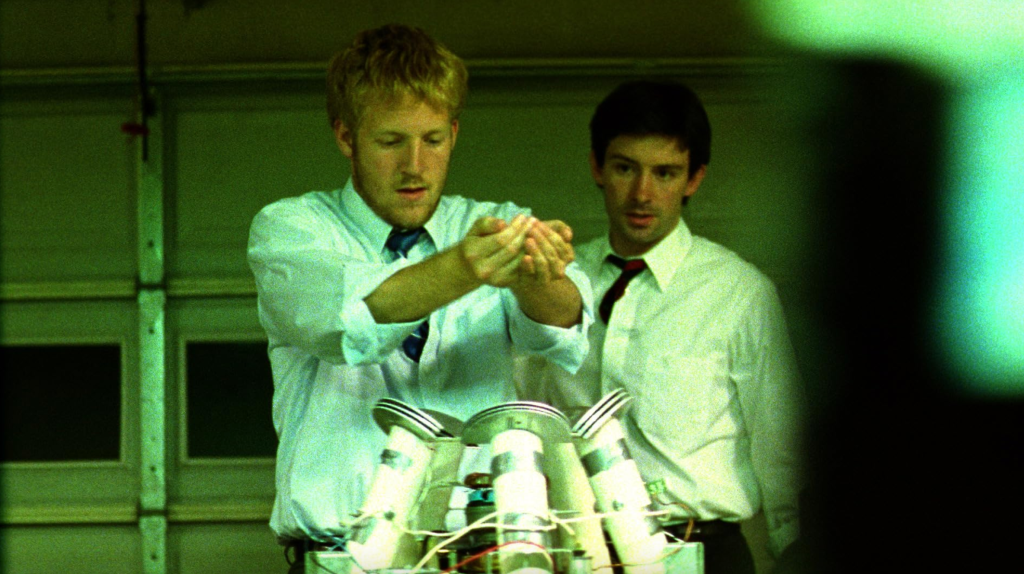
What is it really about?
Ah, Primer. A film with such a grainy image that at first I thought the Sandman himself had poured his sand over the celluloid. And unfortunately for me, he even managed to lull me to sleep twice. BUT: I confess that this was neither due to the film, nor to the picture, and certainly not to the Sandman, but simply to my own exhaustion. Because Primer is absolutely thrillingly staged – and that without special effects, chases or explosions.
From the rather simple hook “two technophile friends build a box with which they can travel into the past” a complex thriller develops. After 30 minutes, the further course of the plot is no longer predictable, as several turning points mark the second half of the film.
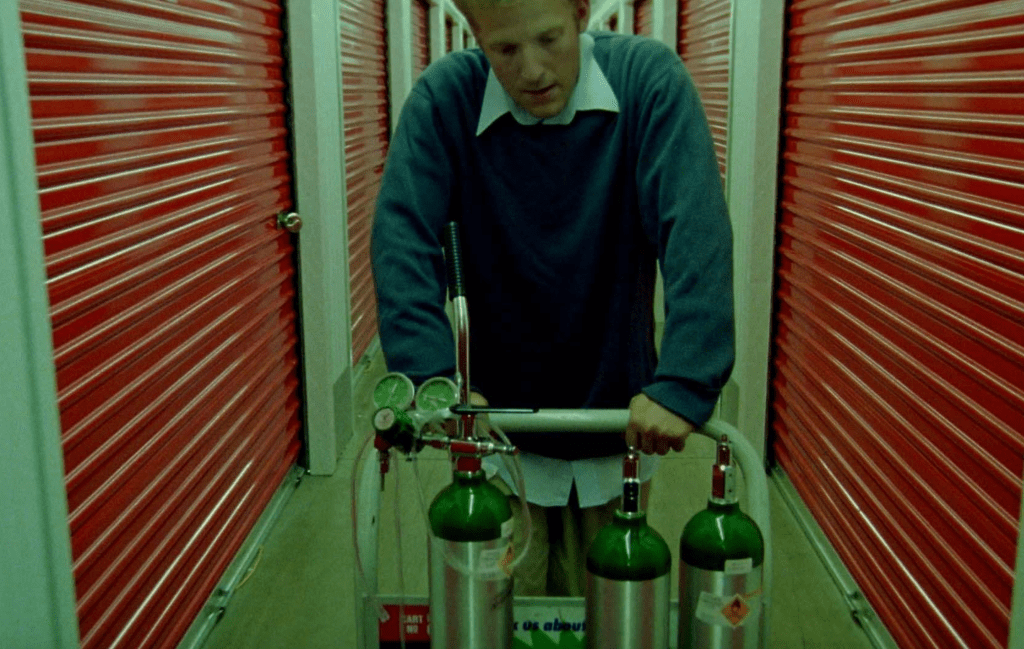
Increasingly, a mangled patchwork of nine different timelines is spread across the viewer’s brain. Since the plot is not advanced stringently, but only in bits and pieces and in many time jumps, the viewer is forced to thread the patches himself.
To make matters worse, the film only sparsely communicates to the viewer which timeline the characters are in (not even when characters from past timelines bump into characters from the present/future). Only in the last 15 minutes is anything like a manageable sequence of plot points/timelines uncovered from the tangled pile of plot salad. This sounds exhausting and cerebral, but fortunately you don’t need five PhDs and a professorship in physics. Even if you can’t break down all nine timelines in detail after watching for the first time, what you got to see is enough to understand the characters, their actions and their effects.
In my opinion, it is this very trick that makes it an intelligent film – quite the opposite of the “oh-so-highly-complex” Inception. In Inception, the viewer has to trudge through an hour of explanation before being allowed to popcorn-smacking adventure. However, the second hour of Inception is so trivial and self-explanatory that it in no way justifies the first hour in that form. Currath at least assumes that the viewer has enough intelligence to come close to understanding the connections between the plot points that are laid out – and he does so without explaining each step in great detail.
To that extent: More of this, please.
Conclusion
Inception for intelligent people.
Crew
Original Title
Length
Director
Cast
Primer
76 Min
Shane Carruth
Shane Carruth as Aaron
David Sullivan as Abe
Casey Gooden as Robert
Anand Upadhyaya as Phillip
What is The Stranger’s Gaze?
The Stranger’s Gaze is a literary fever dream that is sensualized through various media — primarily cinema, which I hold in high esteem. Based on the distinctions between male and female gaze, the focus is shifted through a crack in a destroyed lens, in the hope of obtaining an unaccustomed, a strange gaze.
 The Stranger's Gaze